Category: Uncategorized

  • West Dean Guitar Festival

    West Dean Guitar Festival

    Off to the West Dean Guitar Festival this weekend. I will have just 2 guitars with me – a Romanillos model (left), and the spruce/maple Torres model (right) shown below.

    If you’re at West Dean on Sunday, come and say hello!

    James

  • 12-hole tie-blocks

    12-hole tie-blocks

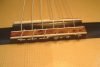
    Most of my guitars now use 12-hole tie-blocks, rather than the traditional 6-holes.

    12-hole

    There are a few advantages – they look neater, the basses are very simple to tie, and they give a more consistent and slightly larger break angle for the strings over the saddle. However, although the basses are very simple to tie, the trebles need a bit more care, and it’s very important to make sure the strings are tied correctly. Poorly tied strings (with either 6-hole or 12-hole tie-blocks) can lead to the end of the string slipping out of the tie-block, whipping round, and hitting the soundboard with some force, causing damage of this type:

    To avoid this you need to know how to tie the ends of the strings correctly. I’m hoping to make a video soon to supercede the rather out-of-date instructions previously published.


  • Classical Guitar Retreat, Cumbrae, 2016

    Classical Guitar Retreat, Cumbrae, 2016

    I returned home a few days ago from another very enjoyable visit to the Isle of Cumbrae in Scotland for the 8th Classical Guitar Retreat. I’ve been fortunate enough to have exhibited my guitars at all but the first of these retreats run by Matthew McAllister.

    A new feature of the event this year saw a selection of luthier’s guitars played in the great setting of the Cathedral by Elina Chekan. It was a good opportunity for participants (and luthiers) to hear the guitars played side-by-side in a nice acoustic. It is difficult to make comparisons between guitars even in ideal conditions such as this, but I was happy that one of the two guitars that I thought stood out was one of my own! All were good guitars though, and in the end a lot comes down to personal preference.


    CGR01


    Highlights of the event included concerts by Matthew (some solo pieces and duets with Allan Neave and Aisling Agnew), Rene Izquierdo and Amanda Cook. Sadly I missed the concert by Patrick Kearney, but he did visit the guitar exhibition and tried out both of my guitars.

    Talks

    There was a very interesting talk by Uros Baric. Lots of useful information about recording techniques and setup, and using editing software. Worth a look at his website here if you want to start or improve your own recordings. Uros is an excellent player, and got into recording after some less than ideal experiences in existing recording studios.

    I also gave a talk myself about guitar making. I’ve given a number of talks at the CGR in previous years, this time I decided to look in more detail at just a few parts of the process. As well as some detailed photos, I showed a few short videos covering the initial stages of making the neck, scraping the sides to the correct thickness, and French polishing.

    One of the photos from my talk showing a circle cutter being used to cut the edges of the channel for the next part of the rosette.


  • Birth of a guitar

    Birth of a guitar

    It’s always a special day when the strings go on a new guitar. Well, actually the special day is a few days after the strings go on, as I’ve found that playing a new guitar as soon as the strings are up to pitch can be a mistake. In those first few hours/days, the strings are not stable, so it’s difficult to keep the guitar in tune, and it also seems that a new guitar requires a few days to settle under the tension of the strings before it performs well.


    Anyway, this is guitar #104 – European spruce top, Indian rosewood back and sides, cedar neck, ebony fingerboard and Alessi tuners. This guitar was built for Kent Guitar Classics, and was delivered to Miles last weekend. I’m very pleased with the guitar, and also very happy to have Miles Roberts representing me.

  • French polishing DVD review

    French polishing DVD review

    See below a very nice review of my French Polishing DVD by Roy Courtnall (author of Making Master Guitars). The course is no longer available as a DVD, but can be viewed online. Email me for details of how to access the course.


    “Many practical skills can be learnt by reading a relevant book on the subject, but learning to play a musical instrument is not one of them; we all know how important it is to be taught properly by a good musician who is also a communicative teacher.

    DVD03

    French polishing is another skill that is almost impossible to pick up convincingly from a book, and more specifically, French polishing a guitar is even more tricky and awkward than normal, due to the difficult shapes involved, as well as the knowledge that its eventual owner will scrutinize it without mercy.

    English guitar maker James Lister (who featured in the November 2012 edition of Classical Guitar) has produced a DVD that demonstrates comprehensively how to French polish a guitar. By enlisting the help of a professional film maker who takes charge of the filming and editing, Lister himself is free to concentrate on the entire polishing process.

    He starts with one of his own newly built guitars ready to be varnished, and carries out each stage of the process, often in real time. Although he prefers the ‘natural’ look of rosewood with unfilled pores on his own instruments, he nevertheless goes through the traditional, painstaking process of filling the grain with pumice powder and shellac, which gives a completely smooth surface on which to polish; a smooth glossy surface remains the finish of choice with many makers and players and thus this is a process that every maker needs to master.

    The quality of the filming is excellent; for example close up shots of the rosewood back clearly demonstrate when the pores are open and when filled. Even the soundtrack accurately gets across the varying sounds made by the French polishing ‘rubber’; sounds which change according to the shellac/alcohol/oil mix being used at the time. These are the subtleties impossible to portray on the written page.

    We see how to combine shellac flakes with alcohol to make up a fresh polish mixture and each step in building up the required shellac thickness is carried out, cutting back when necessary, building up again, smoothing the surface, burning off the oil, and finally bringing the surfaces to a high gloss. The stages at which the polish must be reduced in strength, and exactly when to introduce more or less alcohol and oil are explained in detail.

    Lister’s calm and patient manner make it a pleasure to watch. The DVD runs for around two and a half hours, and being divided into bookmarked sections, the viewer can easily move around to drill deeper into any area that needs to be re-visited.

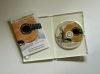
    The DVD is presented in a box together with a professionally-printed A5 size booklet that summarizes the major contents, as well as giving useful information about where to obtain all the necessary supplies.

    So for any guitar maker or player who would like to understand how to obtain a brilliant professional finish on a guitar, this DVD is highly recommended.”

    Roy Courtnall Summerfield