
French Polishing course now available online
As physical media such as DVDs seem to be fast becoming a thing of the past, I have now made the French polishing course available online. Apart from the advantage of not needing a DVD drive to view the videos, it also has allowed me to do a little more editing, to reduce the length slightly without losing any significant content.
The course will also be a little cheaper, as there are no ongoing production costs, or packing/shipping expenses. The printed notes that are included with the DVD have been updated, and added to the online course as downloadable files.
If you’re interested in the online course, please send me an email. I will then send you a referral link which will give you access to the course, and you will pay the course fee to the course host (of which I receive a percentage). The price may vary slightly depending where you are in the world, but should be around £35 (GBP).
Content
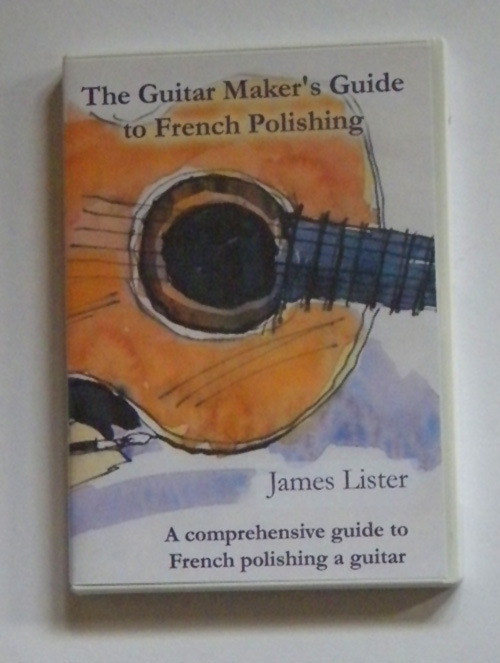
French polishing has been used for finishing musical instruments for hundreds of years, is still the preferred method of finishing classical guitars.
This DVD based course follows the process of French polishing a guitar, from preparation of the surfaces, through filling of the grain, building up the shellac, and the critical final stages required to achieve a professional finish. Chapters and Sub-headings allow for easy navigation through all the stages. One chapter is devoted to the materials required, and these are listed in more detail, along with suggested suppliers, in the accompanying booklet. The booklet also contains a summary of the contents of the DVD, and some additional material, and is divided into the same Chapter and Sub-headings as the DVD itself. Running time is approximately 150 minutes.
What is French Polish?
The term “French polish” actually refers to the technique used to apply the finish, rather than the material used, but in general French polishing refers to a shellac finish applied with a rubber or pad, and built up slowly with very many coats. The material itself, shellac, is produced from a resin secreted by the lac beetle, which is processed to form flakes, which are then dissolved in alcohol to produce a liquid polish.
There are a number of finishes that can be used for classical guitars, so why use shellac? Firstly it’s a very beautiful finish when applied well. It is also non-toxic, and it is a relatively easy finish to repair. Finally, and perhaps most importantly, it is possible to produce a high gloss without building the finish up to a thickness where it would dampen the vibrations of the soundboard.
Chapter Summary
- Introduction
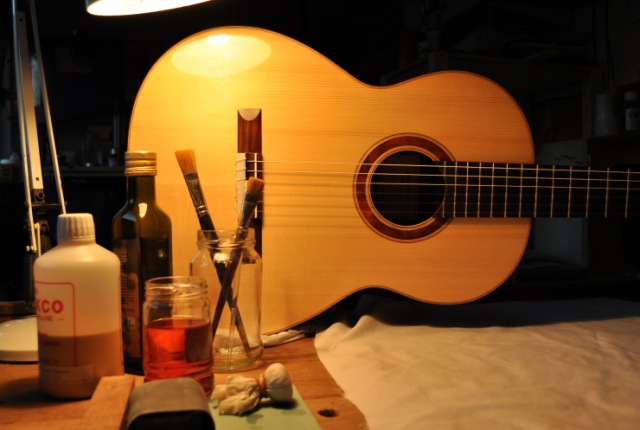
- Materials
- Preparation
- Surface Preparation
- Raising the Grain
- Masking Off
- Basic Technique
- Introduction
- Coats vs. Sessions
- Grain Filling
- Sealing
- Filling the Grain
- Filling on the Head
- Bodying Up
- First Polishing Session
- Sanding Back
- Further Sessions
- Spiriting Off
- Final Polishing Session
- Burnishing
How to access the course
Physical DVDs are no longer available
To access the online course, please send me an email by clicking the button below. I will then send you a link to access the course.
Reviews
Click the button below to see the review of the DVD featured in Classical Guitar Magazine, March 2013
Testimonials
I have found the video very comprehensive and detailed and very good value, exactly what I was looking for.
Many Thanks